
A newly issued U.S. patent — U.S. Patent No. 12,504,645 B2, titled Holographic Display — perfectly captures this moment. Invented by my friend and partner, Robert Safari
By Alki David
Artificial intelligence has spent years living behind screens. We type into it, speak to it, and view it through phones, laptops, and monitors.
But the next phase of AI is about to feel very different.
As AI grows more personal, visual, and conversational, the industry is shifting toward something tangible: desktop AI companions, hologram-style displays, digital avatars, and interactive visual assistants that occupy real space in your world.
A newly issued U.S. patent — U.S. Patent No. 12,504,645 B2, titled Holographic Display — perfectly captures this moment. Invented by my friend and partner Robert Safari, the patent describes an elegant cylinder-style display architecture that makes visual media appear to float inside a three-dimensional viewing space. No special glasses. No complex projectors. Just smart optics and a beautifully simple design that turns a standard display into something that feels alive.
This matters because AI is no longer just software. It is becoming an experience.
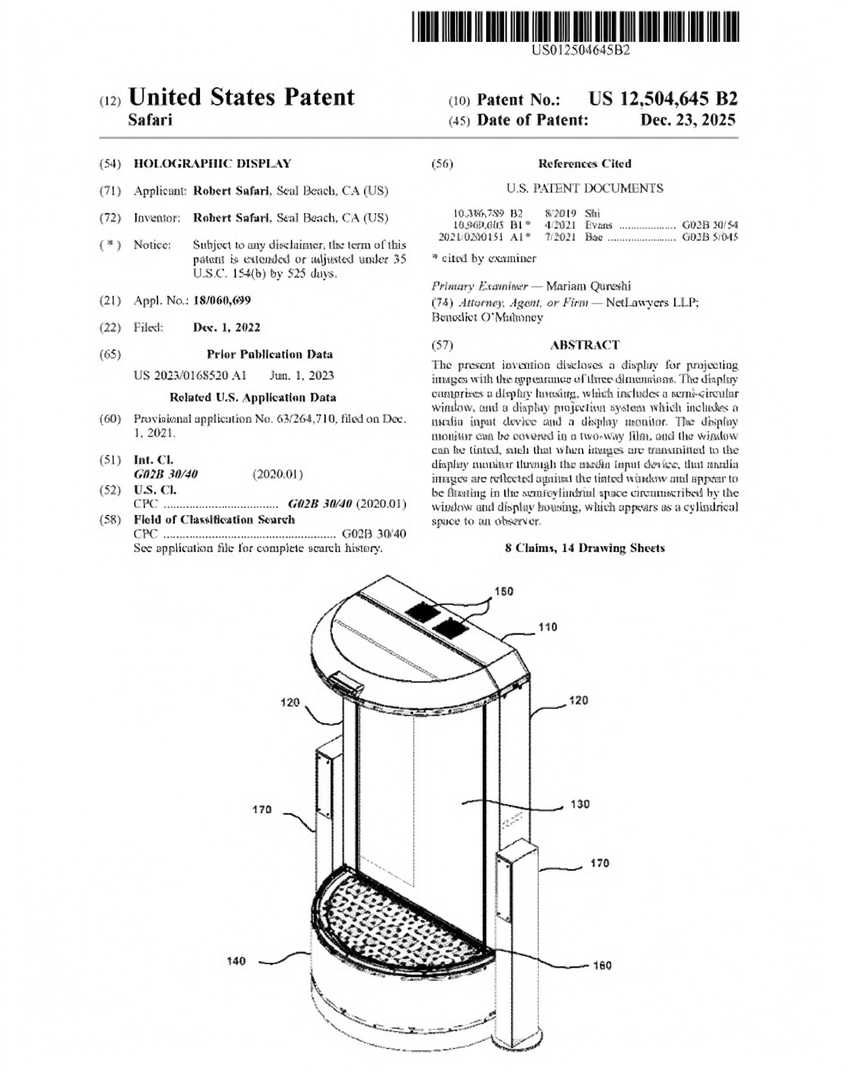
Imagine a compact, desk-friendly device that brings your AI to life — a true visual companion you can place right beside your keyboard. It could serve as:
- A desktop assistant that appears when you need it
- A gaming companion that reacts in real time
- A retail host or brand mascot that engages customers
- An educational guide that makes learning immersive
- Or a digital human interface that feels genuinely present
Instead of staring at a flat chatbot window or talking to a faceless speaker, you interact with something that has presence — something that occupies physical space and commands attention the way a real person would.
For gaming, retail, education, entertainment, and everyday consumer electronics, that presence changes everything. A visual AI assistant that seems to float in front of you is simply more engaging, more memorable, and more human than anything we’ve had before.
The market is still young, but the direction is unmistakable. AI is becoming visual. Hardware is becoming intelligent. Human-computer interaction is becoming personal.
The future of AI won’t just be something we ask questions of.
It will be something we can see, interact with, and proudly place on our desk.
My friend and partner Robert Safari’s groundbreaking patent is laying the foundation for exactly this future. Exciting new products built on this technology are already in development — and I couldn’t be more thrilled to help bring them into the world.
The desktop AI revolution is coming. And it’s going to look incredible.
Alki David Founder, Hologram USA & Anakando Media Group