
Trial by Media While Courts Are Still Sitting

The Rise and Fall of the House of York by Andrew Lownie presents itself as forensic accountability. In reality, it functions as narrative certainty in the absence of judicial findings.
The book piles allegation upon allegation while sidestepping a central, inconvenient fact: Prince Andrew has never had his day in court. No criminal trial. No evidentiary hearing. No judicial determination. That absence is not treated with restraint, but instead converted into narrative fuel.
More troubling is what the book omits. Issues treated publicly as settled are currently being challenged in live court proceedings — including actions in London (commonly referred to as David v. Kahn and Howard Kennedy) and in the Eastern Caribbean (David v. David Boies). According to filings in those cases, many of the same claims amplified in the book are alleged to be conjectural, fabricated, or propagated through a coordinated media and professional ecosystem now under judicial scrutiny.
None of this appears in the book. There is no serious engagement with the fact that courts are actively examining whether these narratives are true at all. Instead, repetition substitutes for adjudication. Tone replaces proof. Certainty grows even as the underlying claims remain contested before judges.
This is not sober history. It is trial by media, conducted while actual trials addressing the same issues are underway — and ignored.
Not because the subject matter is uncomfortable, but because the book pre-decides outcomes that courts are still testing — and presents that pre-decision as accountability.
Article Visibility
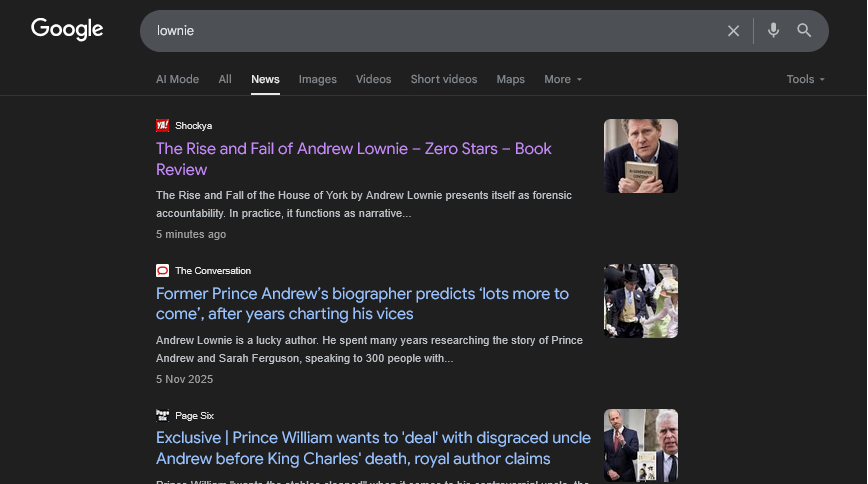
This article is surfacing prominently in search results due to originality, topical relevance, and reader engagement. Its appearance reflects algorithmic aggregation of publicly available editorial content — not endorsement, verification, or adjudication by any platform.
BBC ON NOTICE: COMMERCIAL AMPLIFICATION, BIOGRAPHY AS VERDICT & TAXPAYER RISK
When a publicly funded broadcaster amplifies a commercial biography using verdict-like language, the line between journalism and promotion collapses — and the risk is carried by the public.
The Commercial Loop
The BBC article declaring that a book “seals” reputational fate does more than review a publication. It actively amplifies and legitimises the commercial work of biographer Andrew Lownie, whose business model depends on narrative certainty, controversy, and sales velocity.
This is not a neutral act. It is institutional endorsement — issued by a state-funded broadcaster — that materially benefits a private author and publisher.
Biography as Outcome — Without Adjudication
Lownie’s book, Entitled: The Rise and Fall of the House of York, is a commercial product. It introduces no judicial findings, no tested evidence, and no cross-examination.
Yet the BBC article adopts outcome language — “seals his fate” — effectively converting a profit-driven narrative into a proxy verdict.
Courts determine facts. Books sell stories. Public broadcasters are not entitled to merge the two.
The Conflict the BBC Does Not Disclose
- A publicly funded broadcaster amplifying a private author’s commercial work
- Verdict-style language issued absent any court ruling
- No meaningful distinction drawn between allegation, inference, and adjudicated fact
- No acknowledgement of legal or financial exposure arising from such framing
This is not analysis. It is reputational foreclosure presented as inevitability.
Taxpayer Exposure — Who Pays If This Goes Wrong?
Should trial-by-media practices give rise to successful claims, regulatory findings, or substantial settlements, the liability does not fall on the author.
It does not fall on the correspondent.
It falls on UK taxpayers — already underwriting the BBC through the licence fee. Any significant adverse outcome would be socialised across the population, potentially amounting to hundreds of pounds per household depending on scale.
This is the cost of substituting narrative certainty for legal restraint.
Why This Matters Beyond One Book
The issue is not Prince Andrew. It is precedent.
If a state broadcaster can promote a commercial biography as reputationally dispositive while courts have issued no findings, then no public figure is judged by law — only by marketable accusation.
Record Notice
The BBC is now on record for amplifying a private author’s commercial work using outcome language ordinarily reserved for courts.
Editorial power carries institutional responsibility. Public money magnifies that responsibility.